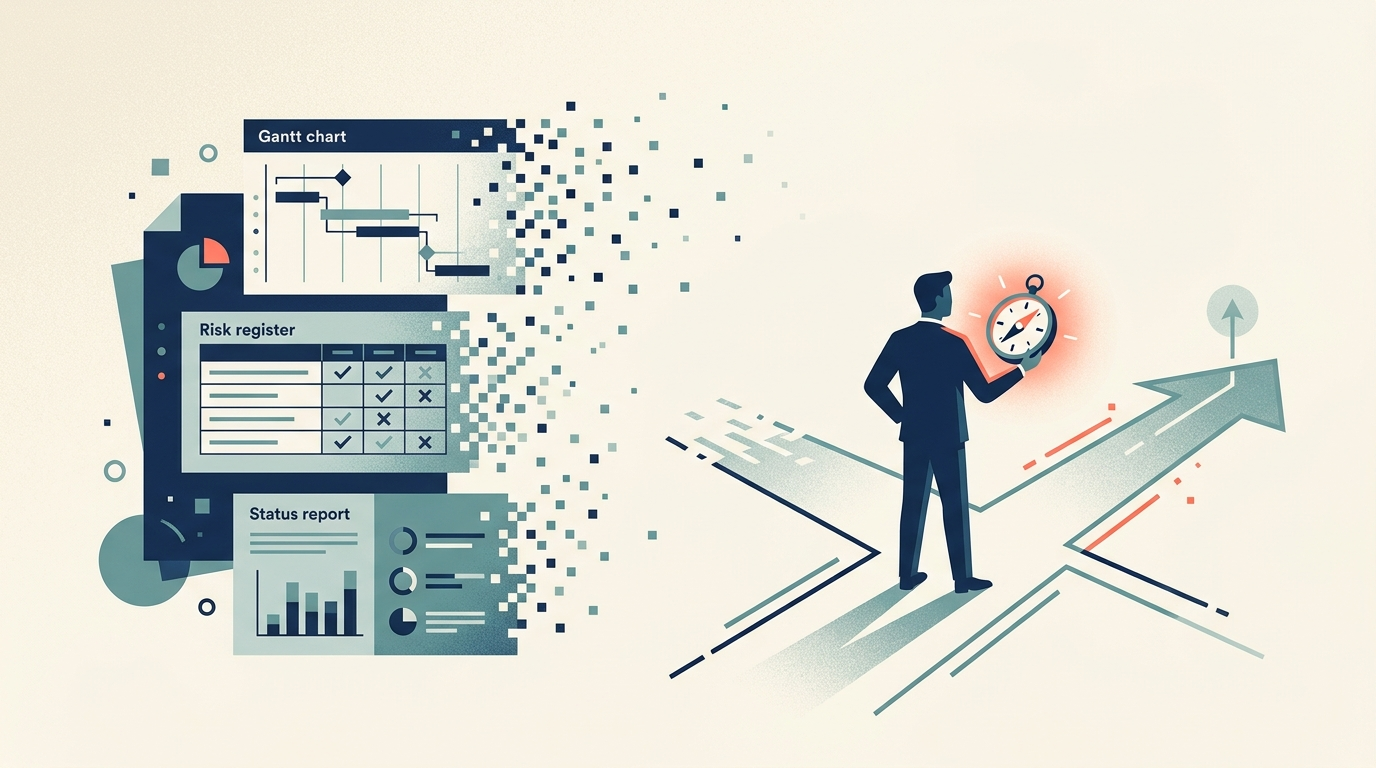
Back in 2019, Gartner predicted that 80 percent of project management tasks — data collection, tracking, status reporting — would be eliminated by AI by 2030. That forecast looked aggressive at the time. Halfway to the deadline, it looks conservative. Today’s AI tools draft project charters, populate risk registers, generate status reports, and flag schedule slippage before a human notices it. The administrative layer of project management is dissolving in real time.
Here’s what makes this interesting for anyone who teaches project management: the artifacts AI now produces in seconds are, in most PM courses, the deliverables students are graded on.
The profession isn’t shrinking. It’s shifting.
The obvious reading — AI automates PM work, so PM careers contract — turns out to be wrong. PMI’s 2025 Global Project Management Talent Gap report projects the project management workforce will need to grow from 39.6 million to 58.5 million by 2035, a shortfall of up to 30 million professionals. Demand is rising precisely as the administrative core of the job is being automated.
Both things are true because they describe different parts of the job. AI is absorbing the work about the work: collating status, formatting reports, maintaining the schedule, drafting the documents. What it isn’t absorbing is the work itself — deciding what to cut when the budget breaks, telling a sponsor the date is going to slip, reading a team that has quietly stopped believing in the plan, choosing between two bad options with incomplete information.
The economics of the role are inverting. When the administrative layer was expensive, a project manager’s value included producing it. Now that layer is nearly free, and the value concentrates entirely in judgment: the decisions, tradeoffs, and conversations that AI drafts can inform but cannot make.
The profession has noticed the gap between where it is and where it needs to be. In APM’s research, only 29 percent of project professionals said they felt adequately prepared for AI adoption. The practitioners are scrambling to reskill. The open question is whether the students now in PM courses will graduate ahead of that curve or behind it.
The awkward question for the classroom
Walk through a typical project management syllabus and count the assessments AI can now complete: the project charter, the WBS, the risk register, the stakeholder analysis, the communications plan, the status report. A capable student with a capable prompt can produce all of them — polished, plausible, and indistinguishable from the submissions of a student who understood the material.
This gets framed as an academic integrity problem, and it is one. But integrity is the smaller issue. The larger one is relevance. If AI can generate the artifact, then the artifact was never the skill — it was a proxy for the skill. The skill was always the thinking underneath: knowing which risks on the register actually threaten the project, recognizing when the stakeholder analysis is politically naive, understanding why this charter will fall apart in week six. AI has simply forced the distinction into the open.
That distinction points at what PM education needs to assess instead: not what students can produce, but what they can decide.
Teaching the layer AI can’t reach
Judgment doesn’t develop from lectures about judgment. It develops from reps — from making decisions under pressure, getting consequences back, and adjusting. Practitioners get those reps on the job, expensively, in their first years of work. The question for educators is how to give students those reps before an employer is paying for the mistakes.
This is where simulations earn their place in an AI-era curriculum. A project management simulation puts the student in the decision seat: running a project or serving as Scrum Master on a live team, absorbing budget pressure, scope creep, team conflict, and a stakeholder who changes the requirements mid-flight. There is no “generate” button for a decision made mid-sprint with the team pushing back. The student either makes the call or doesn’t, and the simulation returns the consequences either way.
Just as important, the instructor finally gets assessment data AI can’t launder. Simulations record the decisions students actually made — who caught the schedule risk early, who overspent chasing scope, who thrived when the sponsor reversed course. Grading shifts from evaluating documents, which AI writes, to evaluating behavior, which it can’t fake.
There’s a useful symmetry here. The workplace is reorganizing around the same split the classroom is: AI handles the artifacts, humans handle the judgment. A course that assesses decisions instead of documents isn’t just protecting its integrity — it’s rehearsing students for the exact division of labor they’re graduating into. Let them use AI to draft the charter, then grade them on what they do when the project stops following it.
The 30 million project professionals the next decade needs won’t be valued for producing documents. They’ll be valued for the judgment calls no model can make. Where in your curriculum do students currently practice those?